
I’ve always swung between the line of pessimist and optimist. In fact, I might call myself an optimistic pessimist, or perhaps a pessimistic optimist. As I’ve gotten older, I feel myself growing more cynical. It’s hard not to with the senseless wars, tragic deaths, greedy politicians, and nutters that insist their gun-toting rights are more important than the lives of children. I almost feel like you’d have to live under a rock to maintain a sense of optimism and an unjaded view of the world.
But of course this negativity does not help things, does it? The most peace-loving leaders our world has known, the same ones who have witnessed the worst atrocities and have been victims to hate crimes, have spread the message of hope. Martin Luther King Jr. said, “We must accept finite disappointment, but never lose infinite hope.” Wise words. And words I have a hard time believing.
But then in September, something happened which made me remember the goodness in people. The kindness of humanity. Those beautiful gifts that the news never shows. PEOPLE ARE GOOD. (Well, not all people. I am not as willing to give the benefit of the doubt to certain heinous humans like Anne Frank did.) But, I think most people have some goodness in them.
On the night of September 15th, I was 8 months pregnant with Edmund. I was alone with my two boys whom I had just put to bed. Ian, an orchestral musician, was playing a concert. At around 9:00 at night, I got a call from a random number. Thank god I picked it up.
“Hej? This is a nurse from the hospital. Is this Lauren? We have your husband.” She couldn’t tell me much more because they didn’t know what was going on with him, but from the gist I got it sounded like he had had a stroke. My mind whirred. I started hyperventilating and sobbing. I had to get to the hospital but the hospital was 30 minutes away. Ian had taken the car to work. I could wait for the train but it was only running once every hour at that time and it didn’t go near the hospital he was taken to. And who was going to watch the kids? I had to get to the hospital now.
I called our friend, Lisbeth, who said she’d rent a car and drive out to watch the kids. She didn’t know how long it would be until she could get the car, but she’d keep me updated. I was overwhelmed by her willingness to come right out and help and even spend her own money to rent a car to get to our house sooner.
Then I ran over to our neighbor’s house. I had never met them before and showed up a mess, crying, trying to articulate what had happened. I asked if they knew if there were any taxis around (there weren’t). The man consulted with his wife and then offered to drive me, a virtual stranger, the half hour to the hospital at night, in the dark. I said I had to wait for our friend to watch the boys. He told me to wait a minute and started making calls around the neighborhood. Soon a woman showed up and said she’d watch the kids until our friend arrived. I couldn’t believe the selfless kindness of these strangers, these people that owed me nothing.
My neighbor drove me to the hospital where I found Ian. It seemed that right before he was about to go on stage, he lost the ability to walk and talk. His whole body became paralyzed for around 30 minutes. Once it passed he had a massive headache and was vomiting from the pain. The doctors were doing all sorts of tests including a lumbar puncture that showed his leukocyte levels were unnaturally high. While we waited for an MRI, I was frantically texting with my cousin (the world’s best nurse practitioner) and her husband (the world’s best trauma doctor). They were there to calm me down and give me ideas of what to ask the doctors during all this. More kindness. More compassion. They checked in several times a day through the whole ordeal which was to last for 6 weeks.

During the MRI, my friend, Victoria, found me. She is a neurologist from Moldova and mother of three and I truly do not know how she does it all. She’s a superwoman and a genius. She led me to a lounge for staff and told me to rest. She brought me water and tissues and let me cry on her and told me all the things that were good about how Ian was doing: he was conscious, he had regained use of his limbs and speech, he was in the best care. She did such an amazing job of calming me down and making me feel like things would be ok.
Ian’s symptoms went away after about 24 hours and after four days in hospital he was able to go home. Then five days later it happened again. I woke in the night to Ian making some very strange noises beside me. He was trying to talk and couldn’t. I tried to get him to stand up, but he couldn’t. I called the ambulance and off he went to the hospital. I followed as soon as I found someone to watch the kids.
More tests. No answers.
After three days he was tired, but normal again, and we went back home. We went to a check-up with our regular GP a few days later and Ian seemed really out of it. When we were leaving he couldn’t stop walking into things: the light post, the door…when I helped him into the car he didn’t know how to put on his seatbelt. So I walked him back into the doctor who called 112 and he was taken to the hospital again. Thankfully the kids were in school so I could go with him until I had to pick them up.
Meanwhile, I was struggling. Besides the emotional toil of not knowing what was going on with my husband, I was struggling physically. I have unpleasant pregnancies. Not only was I huge and having sharp sacro-illiac pain, but I was throwing up several times a day and itching like a meth-addict. During this time I was diagnosed with cholestasis and given a medication that gave me diarrhea and made my vomiting worse. I was very dehydrated. I was told that I would have to be induced two weeks early for the baby’s safety. I was imagining birthing my baby in the North hospital while my husband was in a ward in the South hospital.
I decided I needed help. I was tired from pregnancy and its complications, chasing around 2 young boys, and emotionally drained from caring for my husband at the hospital all on no sleep. My in-laws offered to come. Until now I had said, “no, we’ve got it!” because I didn’t want to be a burden. But now I needed them. They bought tickets immediately and flew out the next day.
Meanwhile my siblings and their partners were buying us meals so I didn’t have to worry about cooking and offered to fly out as well. My parents bought furniture for our annex so my in-laws had somewhere to stay when they got there, and my mom bought tickets to stay with us for five weeks when my in-laws had to leave. Very very kind colleagues from both Ian’s work and my own came to babysit the kids, make meals, and clean out the annex for my in-laws (it was still full of moving boxes). They helped when, upon the arrival of my in-laws, we all came down with a nasty flu bug that left us pretty immobile. Turns out it’s pretty hard to take care of a four-year-old and two-year-old when you can’t leave the bathroom. Other friends and colleagues took our dog, Harold, to stay with them until we were back on our feet.
During this time, the infectious disease doctors who were on his case were bandying about diagnoses like migraine with aura, TIA (mini stroke), and meningitis. For awhile they thought it was encephalitis. There was talk about inflammation of the brain which freaked us out. It wasn’t until a month later that we learned this was a communication error. The cerebral fluid was infected, but the brain wasn’t actually inflamed. The only person who guessed what would ultimately become the diagnosis was Victoria. She knew right away. Only a couple days after Ian was first admitted to the hospital, she and another neurologist came to our room.
“I think he might have a rare disease called HaNDL,” she told us. Apparently it had only ever been recorded once before in the history of that hospital. Victoria began to research the disease (even though we were not in her ward and she was busy with a million other things.) She was pretty convinced that this was what he had even though the other doctors remained skeptical. HaNDL is a disease that is so rare it can only be given an exclusionary diagnoses – that is, if every test came back negative, then the doctors would diagnose Ian as having HaNDL.
Over the course of a month and a half (much of which was spent in the hospital), and after a total of twelve of these paralysis attacks followed by severe headaches and vomiting, Ian was finally diagnosed with HaNDL and we were overjoyed. It was the best case scenario. He would regain full brain function and should not suffer any lasting issues as a result. He recently received another lumbar puncture and his leukocyte levels were almost normal.
He was there for the induction and birth of our third beautiful boy, Edmund.
As I write this, I find I am emotional reliving this time. I feel overwhelmed with gratitude for these kind people who didn’t have to help, but went out of their way to make our lives easier, to support us, to love us. Whenever I am starting to feel jaded about the state of the world and the people in it, I want to remember this time. It is hard to accept help, but what a gift. I could not have gotten through this without these people. I wish I could pay them back. And I just wanted to thank them.
Thank you to the doctors and nurses, especially Victoria, for solving the puzzle. Thank you to my in-laws who dropped everything to be with us for a month and shuttled the kids back and forth to school and watched them while I was at the hospital with Ian. Thank you to my mom who came to stay with us for five weeks and cooked, cleaned, and provided us with all the support during those early newborn days. Thanks to my family for constantly checking in, for the meals, and for the love. Thank you to all my Skipper Clement Skolen colleagues and pals for taking care of Harold, babysitting my kids, and bringing us food, all with cheery words and bright smiles. Thank you to Ian’s colleagues and friends at the Aalborg Symfonieorkester who shuttled me and my in-laws around, cleaned and organized the annex, and helped with paperwork for Ian’s sick leave. Thanks to Lisbeth who came right away when I called, made food, and helped with Harold. Thanks to my neighbors who were so willing to help this new-to-the-block crazed American stranger with the super loud dog. Thanks to Claire and Mark and my friends from the States who were checking on me through text and Facetime. I’m sure I’m missing others, and if I am, I’m sorry, and thank you. Also a special thank you to Denmark for having national healthcare so Ian and I didn’t have to go into debt to pay for his care at the hospital.
I feel very lucky and very loved. And having relived this challenging time through writing about it, I feel more inclined to agree with Martin Luther King Jr’s quote on hope. As corny as it sounds, I truly believe that where there is kindness, there is hope.
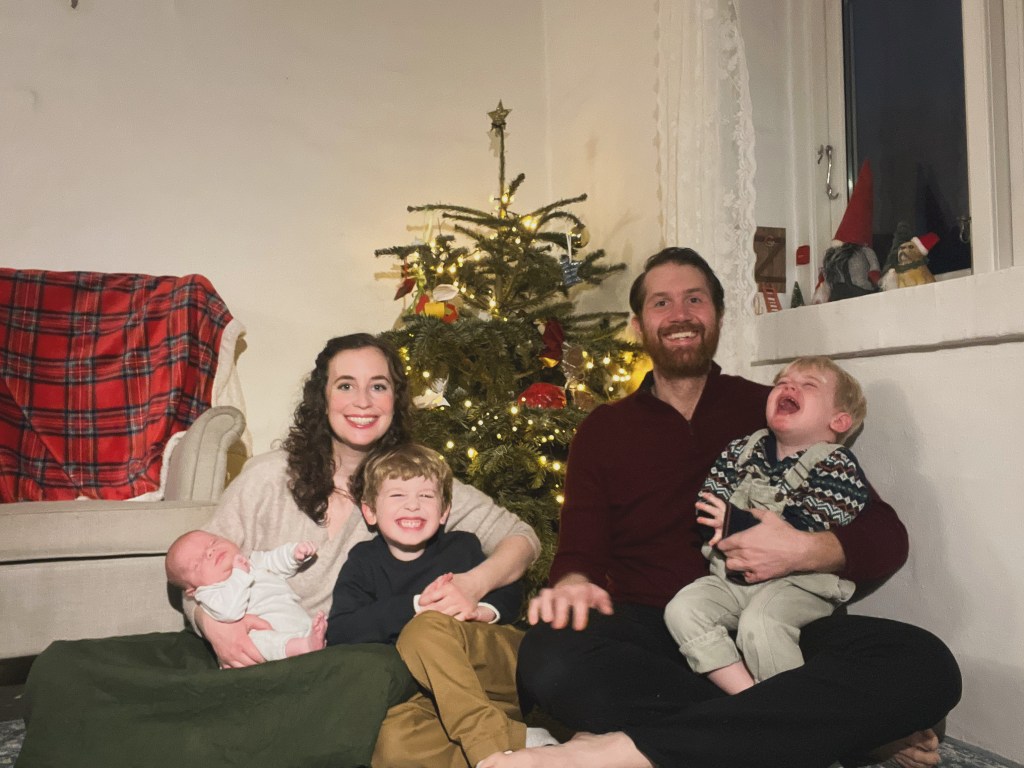
Well…hope and toddler tantrums.

 Lauren in ScandilanD